Who is this article for?
In a practice with several practitioners, you may want each practitioner to only see their own clients. Colib lets you do this practitioner by practitioner: when the option Ability to see other practitioners information is turned off for a practitioner, they only see the data of the clients assigned to them.
This article explains how to restrict what a practitioner sees, how to assign one or several practitioners to a client, and which notifications the client's main practitioner receives. It starts with a summary of the access control per file that Colib offers.
Before you start: the rights of the practitioners are set in Settings > Team (www.colib.io/settings?show=team), by an administrator who has the option Ability to edit team members’ details and permissions. The practitioners of a client are chosen in the client record, by anyone who can edit client records.
Access control per file
Can several practitioners work on the same file? Yes. In a practice, a client file can be shared with colleagues or restricted to a few practitioners. This is the Access Control per File presented on our Client Files & Notes feature page (www.colib.io/electronic-client-records). Colib offers three levels:
| What you want | How to do it | Where |
|---|---|---|
| Share a client file with colleagues | Assign the client to several practitioners: a main practitioner and as many additional practitioners as needed (Additional practitioners assigned to the client). | Step 2 below |
| Restrict a file to its practitioners | For the practitioners who must only see their own clients, turn off Ability to see other practitioners information and, if needed, Access to notes created by other practitioners for shared clients. A practitioner restricted this way only sees the files of the clients assigned to them. | Step 1 below |
| Restrict a single document to chosen practitioners | In the window of a document of the client, turn on Restrict access and choose the Authorized practitioners, among those who already have access to the client. | Please see the article titled "How to add a document to a client". |
Access rights follow each user's access levels: what a team member can see or change in a record (notes, documents, invoices...) depends on the rights set for them in Settings > Team (What are the different levels of rights/options for the members of my practice?). Every view, creation, change, deletion and download of client information is written to the activity log (Complete Audit Trail): see How to access the activity log.
No reason or review date for practitioners: restricting what a practitioner sees does not ask for a reason or a review date. A documented reason and an end date are recorded only when you temporarily withhold the client's own access to their record in the client portal. Please see the article titled "How to temporarily withhold a client's access to their record".
1Limit a practitioner to their own clients
- Go to www.colib.io/settings?show=team and click the pencil icon on the row of the practitioner.
- In the Rights section, turn off Ability to see other practitioners information.
- If needed, also turn off Access to notes created by other practitioners for shared clients: the practitioner will then only see their own notes, even for a client they share with a colleague.
- Click Save.
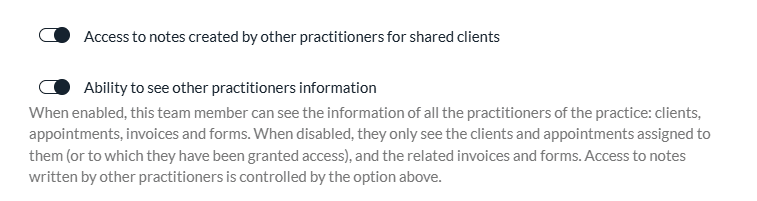
With this option turned off, the practitioner only sees the clients assigned to them and their appointments, as well as the related invoices and forms. The other clients of the practice, including the clients assigned to nobody, do not appear in their client list or in their searches.
Only for practitioners: the option is kept turned on for team members who are not practitioners (a receptionist, for example): they always see the clients of all the practitioners, within the limits of their access levels. All the rights are described in What are the different levels of rights/options for the members of my practice?
2Assign practitioners to a client
A practitioner is assigned to a client when they are either:
- The main practitioner of the client (the Practitioner field), or
- An additional practitioner, selected in the Additional practitioners assigned to the client list. A client can have as many additional practitioners as needed.
- Open the client's record from your client list (www.colib.io/clients).
- Click the Profile tab, then open the General Information section.
- Choose the main practitioner in the Practitioner field.
- To share the client with other practitioners, click the button under Additional practitioners assigned to the client (Select options when nobody is selected yet) and tick each practitioner.
- Click Save at the bottom of the page.
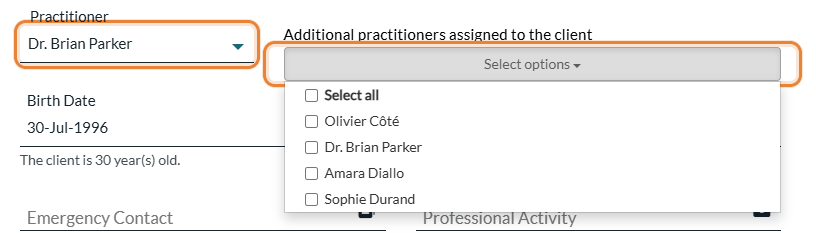
When you choose someone else as the main practitioner, that practitioner receives a notification in Colib telling them that they have been assigned as the primary practitioner of the client.
3Check who receives the notifications
The main practitioner of a client is the person Colib notifies about this client:
- Completed forms — if the notifications for completed forms are turned on in Settings > Forms (www.colib.io/settings?show=signature), the email goes to the client's main practitioner. For a client with no main practitioner, it goes to the Default user receiving the notifications.
- Delivery problems and payment disputes — the main practitioner is notified in Colib when an email or a text message to the client could not be delivered, or when the client disputes a card payment.
The notifications of appointments booked, rescheduled, confirmed or cancelled, and of waitlist requests, follow another setting: in Settings > Communications (www.colib.io/settings?show=communications), in the Event notification recipient section, choose Clinic, Practitioner or Clinic and practitioner for each event. With Practitioner, the notification goes to the practitioner of the appointment or of the request.
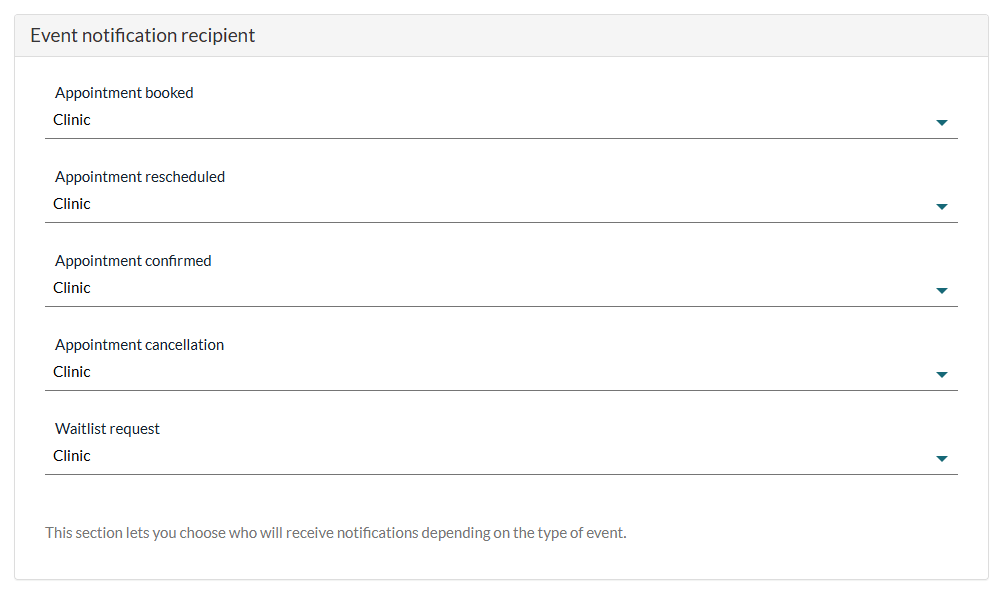
How the main practitioner is set automatically
- New client who books online — the practitioner chosen on your booking page becomes the main practitioner.
- Client added to an appointment — if the client has no main practitioner yet, the practitioner of the appointment becomes their main practitioner.
- Client created in Colib — the Practitioner field is pre-filled with the person who creates the client. You can change it.
To have returning clients book with their own practitioner, turn on Automatically select the practitioner of the client in Settings > Booking Page (www.colib.io/settings?show=bookingpage). The booking is then assigned to the client's main practitioner, provided the client is identified during the booking and their practitioner offers the selected appointment type.

Good to know
- A practitioner leaves the practice — when you remove a team member, their clients no longer have a main practitioner. Reassign them first: otherwise, the practitioners who only see their own clients will not see them.
- Several clinics — in a multi-clinic practice, a team member only sees the clients of the clinics they are associated with, even with the option turned on. See How does creating multiple clinics affect practitioners' rights?
- Access levels still apply — being assigned to a client does not give more rights: what the practitioner can see or change in the record (notes, documents, invoices...) depends on their access levels.
- Client Files & Notes feature page — for an overview of client records in Colib, see www.colib.io/electronic-client-records.
- A practitioner sees no clients at all? — please see the article titled "A team member sees an empty account or an error page: what should I do?"
Still have a question?
Write to us at support@colib.io, we will be happy to help.
Was this article helpful?
That’s Great!
Thank you for your feedback
Sorry! We couldn't be helpful
Thank you for your feedback
Feedback sent
We appreciate your effort and will try to fix the article